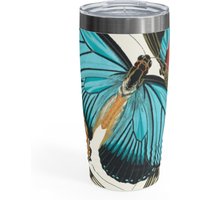
Yes for the ceramic mugs, no for the steel. A sublimated mug carries its design inside a polymer coating that is part of the mug surface rather than a layer stuck on top, and 567 of the 594 ceramic mug listings this site tracks state dishwasher safe, with 570 stating microwave safe. Printed stainless tumblers are the opposite case: 402 of 604 tumbler listings specify hand wash only, and no insulated steel cup belongs in a microwave. What fails in practice is not sublimation but added-on decoration, plus any mug that is scoured with an abrasive pad or run on a sanitize cycle for years.
What the listings actually say, counted
Ceramic mugs (594 listings)
567 state dishwasher safe, 570 state microwave safe, 554 describe the body as ceramic.
Accent mugs (129 listings)
121 carry the same dishwasher-safe and microwave-safe lines as the plain ceramic mugs.
Stainless tumblers (604 listings)
402 state hand wash only. Exactly one mentions a dishwasher at all.
Frosted glass cans (21 listings)
Described as 16 fl oz sublimated glass with a bamboo lid and a straw. No dishwasher claim is made.
Those counts come from the merchant's own listing text across the 1,200 mug and drinkware products tracked here, not from a general rule about ceramics. The practical takeaway is that material predicts care almost perfectly in this catalog: ceramic goes in the machine, steel does not. Where a listing carries a care line, that line beats anything on this page.
Sublimation is not ink resting on a surface. The blank mug ships with a polymer coating already fired onto it, and Sawgrass, which makes sublimation printers and inks, specifies that a mug needs that coating for the dye to bond, with ceramic mugs pressed at roughly 350 to 400 degrees Fahrenheit. At that heat the solid dye turns to gas and moves into the coating, then cools trapped inside it. There is no raised layer for a jet of hot water to get under.
That is why the failure mode for a sublimated mug is gradual fading rather than peeling, and why one UK sublimation mug producer rates its mugs at over two thousand dishwasher washes. If a printed mug of yours has ever peeled, it was almost certainly not sublimated.
Three forces wear a printed mug down, in this order. Heat is first: the polymer that holds the dye softens well below the temperature of a sanitize cycle or a mug left soaking in near-boiling water, and a softened coating fades at the edges of the design. Detergent chemistry is second, since aggressive powder detergents are harsher on the coating than gel or liquid. Abrasion is third and is the one people cause themselves, by taking a scouring pad to the printed side.
Anything added on top of a finished mug is a different story. Vinyl decals, glitter wraps and metallic paint sit above the glaze as a separate layer, so hot water and detergent can get underneath and lift them. The decision rule is simple: if a listing does not say sublimated, dishwasher safe or both, treat the mug as hand wash.
Fine. Microwaves heat the drink, not the ceramic, and these listings state microwave safe.
Any metallic or gold trim
No. Metal decoration arcs in the field: sparks jump along the trim and can crack the piece and damage the oven.
Stainless tumbler
Never. Steel reflects microwaves, and the sealed double wall has nowhere to vent.
Frosted glass can
The glass itself is not the problem; the bamboo lid and the straw are. Take them off first.
One extra habit worth having: dry the outside of a mug before it goes in. Water trapped under a base ring turns to steam and stresses the glaze for no reason at all.
How to wash a printed mug so the print outlives you
If it goes in the machine, put it on the top rack, away from the heating element, use a gel or liquid detergent rather than powder, and skip the sanitize and heated-dry options. Those three choices cost nothing and remove most of the heat load that fades a sublimated design.
If the mug matters, wash it by hand. Warm water, dish soap, a soft sponge, thirty seconds, and never a scouring pad on the printed side. Do not leave it standing full of boiling water, and do not use it as a soaking vessel for cutlery. For a stainless tumbler, hand washing is not optional advice but the instruction the listings give; the reason is that dishwasher heat and strong detergents attack the powder-coat finish and can stress the vacuum seal that the insulation depends on.
Slowly, over years of hot cycles and harsh detergent, and it fades rather than peels. Peeling is a symptom of a decal or vinyl print, not sublimation.
Are the accent mugs dishwasher safe too?
The listings say so: 121 of the 129 accent mug listings tracked here carry the same dishwasher-safe and microwave-safe lines as the plain ceramic mugs. Check the individual listing for any metallic finish before microwaving.
Can I put a printed stainless tumbler in the dishwasher?
Treat it as hand wash only. 402 of the 604 tumbler listings here state hand wash only outright, and only one mentions a dishwasher, so there is no reason to gamble on the rest.
Does the print touch my drink?
The design is a wrap around the outside wall, and sublimation puts it inside the coating rather than on top of it. The rim and the interior are the mug's own glaze.
What about the microwave for a travel mug?
Depends entirely on the body. Ceramic travel mugs follow the ceramic rule; anything with a steel body or a metal-lined lid does not go in a microwave.
Editorial conclusions are drawn from the Printerval catalog data and the manufacturer documentation listed above; we do not claim to have used every product shown. Updated 2026-08-25. Corrections: contact us.
As an affiliate, Hug-A-Mug earns commission from qualifying purchases made through links on this page — at no extra cost to you. Prices are pulled from the retailer's live product feed and may have changed — the link always shows the current price.